
Keyboard or Piano? What to Buy for a Beginner
Published
You do not need a grand piano to start lessons. Most families begin with a keyboard or a digital piano at home, and that works well. What matters is that the keys are full size and your child can practice on it most days. Below, we compare the three common options and the few features that really matter.
The three options
A keyboard. This is the lightest and least expensive option, and it is easy to move around the house. Most have 61 or 76 keys that feel springy rather than heavy. A keyboard works well for the first months of lessons, especially for young children who are still deciding whether piano is for them.
A digital piano. Usually 88 weighted keys, and on most models the low keys feel heavier than the high ones, like a real piano. Many teachers see this as the best home instrument for a child taking regular lessons. It never needs tuning, and you can plug in headphones.
An acoustic piano. Nothing quite matches the sound and touch of a real piano. It also costs the most, needs tuning about once a year, and takes up a lot of space. If you already have one, or can find a good used one, it is a wonderful instrument to learn on, but you do not need one to begin.
What to look for
- Full-size keys. This one is not optional. Mini keys teach the wrong hand spacing, and your child will have to relearn it.
- Weighted or touch-sensitive keys. Touch-sensitive means a key plays louder when you press harder. Weighted means it also pushes back like a piano. Both help your child learn to play softly and loudly, which is a big part of piano.
- Enough keys. 61 keys covers early beginner music. 88 keys covers everything, so your child never outgrows it.
- A sustain pedal. A simple foot pedal that plugs in is all you need, and it comes into most children's music within the first year or two.
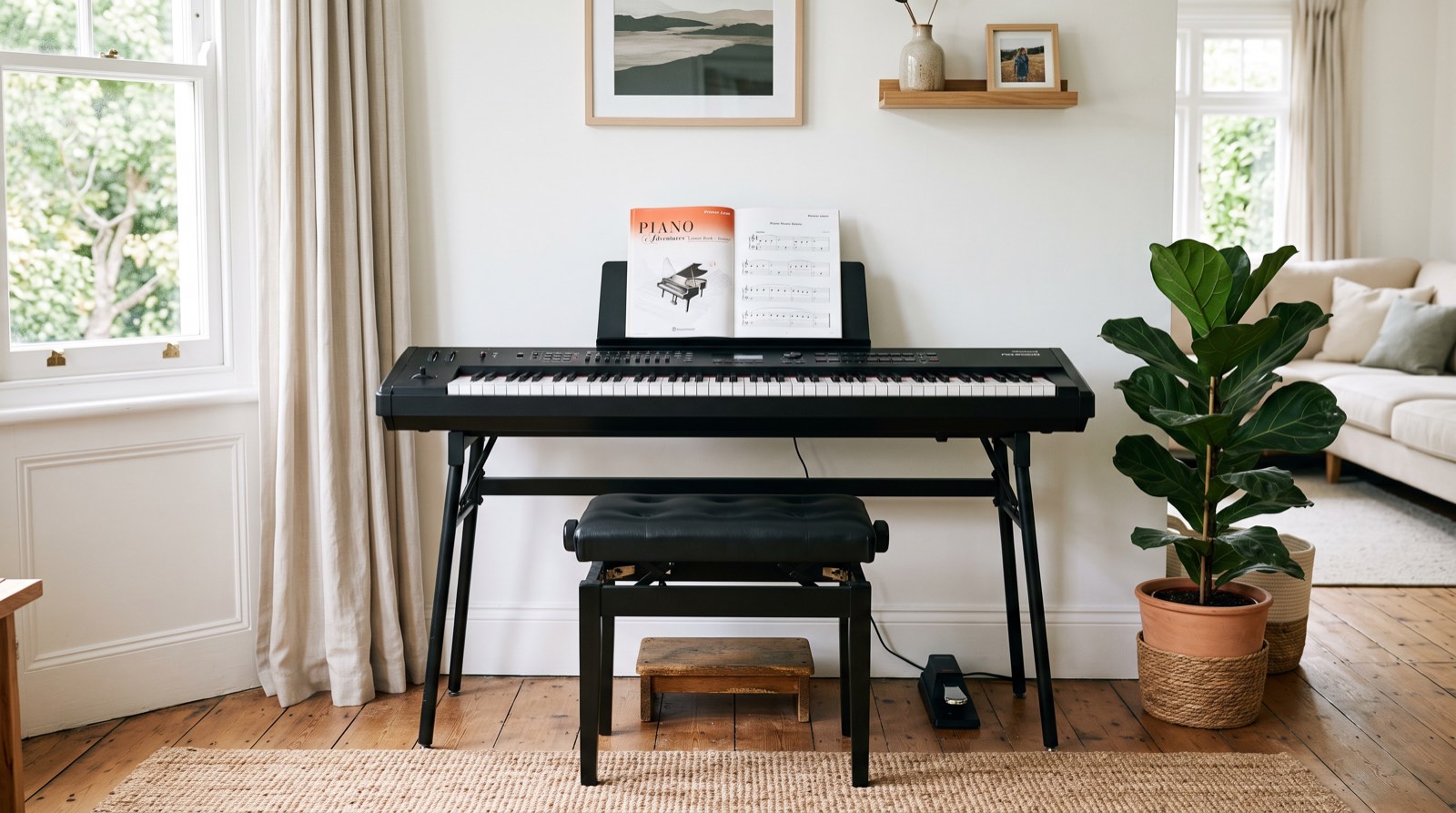
- A stand and a bench at the right height. Your child's forearms should be about level with the keys. An adjustable bench helps, and small children need a footrest so their feet are not dangling.
What we suggest for most families
Just starting, or a child under 7: a keyboard with full-size, touch-sensitive keys is enough for the first several months.
Committed to weekly lessons: a digital piano with 88 weighted keys. It will last for years.
Already have an old piano at home: have it tuned and checked. If it holds its tuning and all the keys work, it is a great instrument to learn on.
Before you buy anything big, ask your child's teacher. They can tell you what fits your child's level and goals, and many have seen the models you are considering.
Where to put it
Put the instrument somewhere your child walks past every day, not a cold basement or a closed room. Good light, a stand for the music, and few distractions nearby. An instrument that is easy to sit down at gets played more. Our guide to how long to practice has more on building the habit.
Piano lessons in Denver
Not sure what to buy yet? Start lessons first. Our piano teachers teach at our recording studio in southwest Denver and online, and online lessons work from whatever keyboard you already have. Your teacher can tell you when it is time to upgrade.
Tell us about your child and we will match you with a teacher, or read our guide to what age to start piano.
Common questions
Can my child learn on a keyboard with 61 keys? Yes, a 61-key keyboard works well for the first stage. Plan to move to 88 keys once lessons are a regular part of the week.
Is a digital piano as good as a real piano? For learning at home, a good digital piano is close enough for years of lessons. Many students never need more.
Should we buy used? Used digital pianos and keyboards are often a good deal. For a used acoustic piano, have a piano technician look at it before you buy.