

How Long Should My Child Practice Piano?
Published
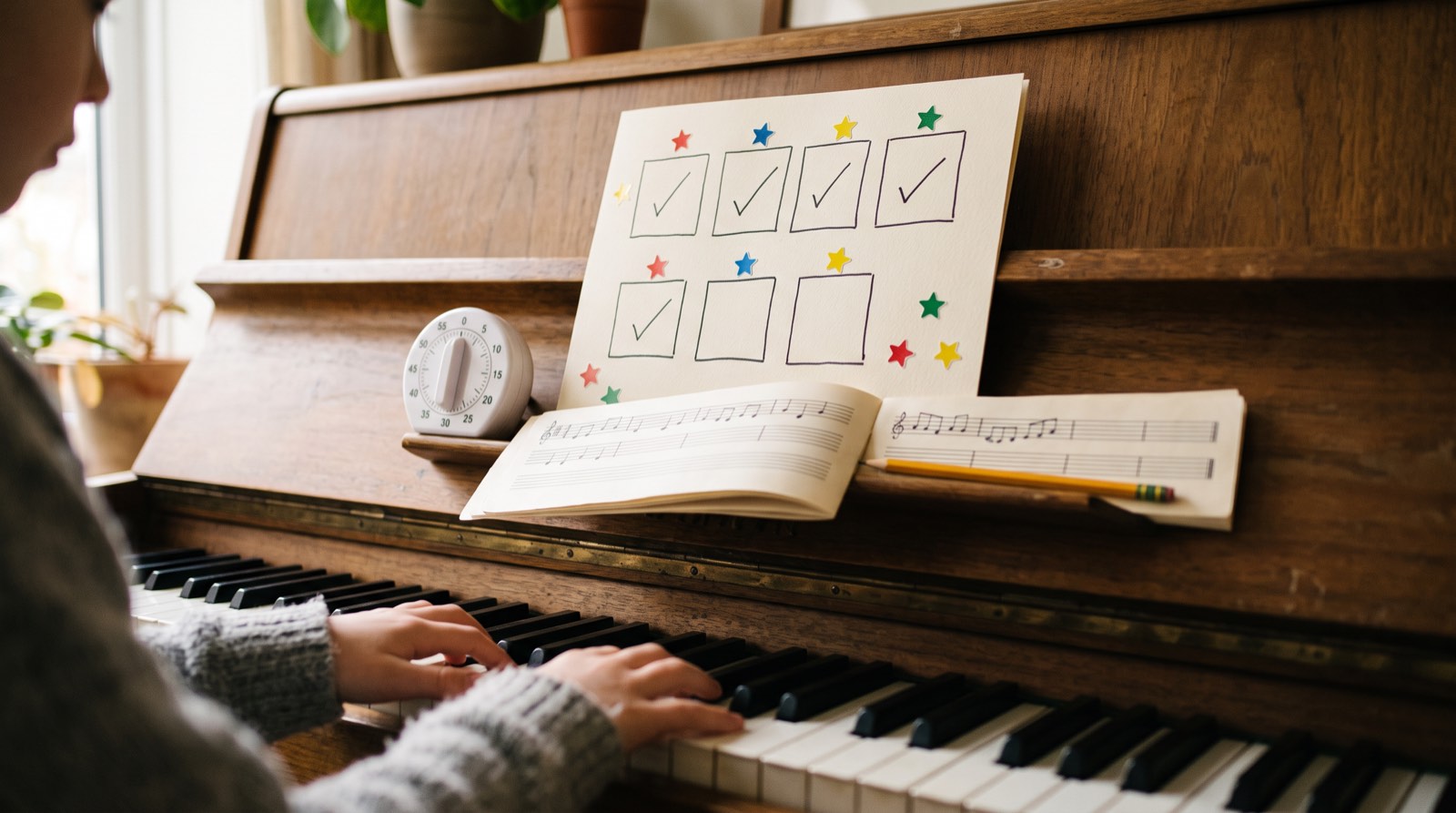
Short and often beats long and rare. For most young beginners, 15 to 20 minutes a day, five or six days a week, does more than an hour crammed in on Sunday. The right amount grows with your child, and what happens in those minutes matters more than the clock.
Here is a simple guide by age, and how to make practice something your child does without a fight.
How long to practice, by age
These are starting points that many piano teachers share. Your child's teacher may adjust them.
- Ages 4 to 6: 10 to 20 minutes, with you sitting beside them.
- Ages 7 to 9: 20 to 30 minutes.
- Ages 10 to 12: 30 to 45 minutes.
- Teens: 45 to 60 minutes, more if they are preparing for something.
Count goals, not minutes
The clock is a rough guide. A better question is whether this week's assignments are getting done well. If your child plays each piece the way the teacher asked, they have practiced enough, even if it took 12 minutes. If they spend 30 minutes playing the easy song over and over, they have not.
Ask the teacher to write down two or three specific things to work on each week. "Play the left hand of measures 1 to 4 slowly, three times" is something a child can finish. "Practice the song" is not.
Make it a habit, not a decision
Pick a time and keep it. Practice that happens "when there is time" rarely happens. Right after school, before dinner or after breakfast all work well. What matters is keeping the same time on most days, so it stops being a decision.
Keep the instrument out. A keyboard in its box in the closet is a chore. A keyboard by the couch with the music open is an invitation.
Split it up. Two 10-minute sessions often go better than one 20-minute session for a young child.
Start with something they like. Open with a song they already enjoy, then move to the new work. Finish on something easy so they leave the bench feeling good.
How to help without taking over
Children under 8 usually need an adult nearby. You do not need to know any music. Your job is to read the teacher's notes, keep the routine, and notice effort.
Praise the work, not the talent. "You played that slowly and carefully" teaches more than "you're so good at this."
Let them be the teacher. Ask your child to show you what they learned this week. Explaining it out loud helps it stick, and kids love being the expert.
Use a simple tracker. A sticker chart or a calendar with checkmarks gives young children something to see. Many families reward a full week with something small.
When practice becomes a fight
Every family hits a rough patch. A few things usually help.
- Shorten it. Five good minutes beats twenty miserable ones. Keep the habit alive and build back up.
- Talk to the teacher. If the music is too hard or too boring, a good teacher will change it. Ask for a piece your child actually wants to play.
- Give a goal. A small family concert, a recording for grandparents, or a song for a birthday gives practice a reason.
- Take a short break if you need to. A week off is fine. A month of tears is not worth it.
If your child is very young and practice is always a struggle, they may simply need a few more months. Our guide to what age to start piano has a quick readiness check you can try at home.
Piano lessons in Denver
Clear weekly goals make practice easier, so ask for two or three at every lesson. Music 4 Humans piano teachers teach kids, teens and adults at our recording studio in southwest Denver and online.
Tell us about your child and we will match you with a teacher who fits, or browse our piano teachers.
Common questions
Is it okay to skip a day? Yes, it is. Five or six days a week is plenty. One or two days off keeps practice from feeling endless.
Should practice be the same length every day? It does not need to be. A short day still counts, and the habit matters more than the exact minutes.
My child practices but is not improving. Why? Usually they are playing through pieces instead of working on the hard parts. Ask the teacher to show your child how to practice one tricky spot slowly.