
What Drum Set Should I Buy My Child?
Published
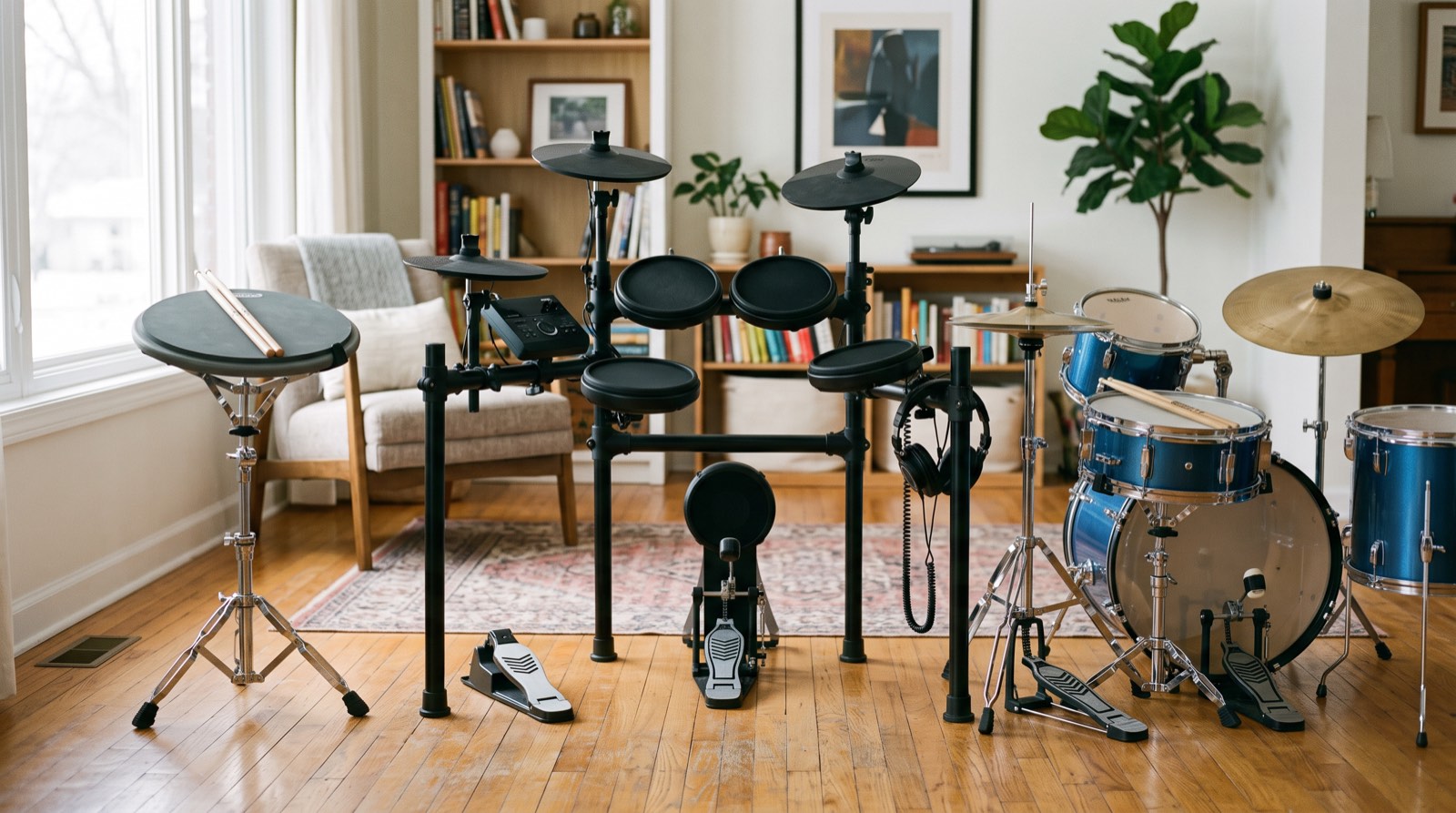
A beginner drummer has three real options: a practice pad, an electronic drum kit, or an acoustic drum kit. You do not need to buy the biggest one first. Many children learn for months on a pad before anyone buys a kit, and the right choice later depends on your home, your neighbors and how committed your child has become.
Start with sticks and a practice pad
A practice pad is a small, quiet surface that feels like a drum. With a pair of sticks, it is everything a beginner needs for the first months: grip, strokes, rhythm and rudiments. It costs very little, takes up no space, and is quiet enough to use while the rest of the family watches TV. In our after-school music classes, beginners often start on pads before they sit at a kit.
A pad on a stand at the right height is more comfortable than one on a table. 5A sticks suit most beginners, and lighter 7A or junior sticks suit smaller hands.
Electronic drum kits
An electronic kit has rubber or mesh pads that trigger drum sounds through a small module. Its biggest advantage is volume: with headphones, the household hears only the tapping of sticks and the thud of the pedal. Most kits also have a built-in metronome and play-along songs, which make practice more fun.
What to look for:
- Mesh pads rather than hard rubber, if you can. They feel more like real drums and are kinder to wrists.
- A sturdy rack that stays put when played and adjusts down for a child.
- A kick pedal that feels like a real pedal, rather than a small button.
- Good sounds. The better it sounds, the more your child will want to play.
What to avoid: roll-up silicone "drum kits" and toy electronic kits. Their pads do not bounce like a drum, and they can build habits a teacher later has to undo.
Acoustic drum kits
Nothing quite matches the sound and feel of real drums. An acoustic kit teaches touch and dynamics in a way that even good electronic kits cannot fully copy. It is also loud, takes up a corner of a room, and needs tuning and new heads now and then.
Junior kits have smaller drums and lower stands, and fit many children under about 9 or 10. Older children and teens usually fit a standard-size beginner kit. Whichever you choose, budget for hearing protection: an acoustic kit is loud enough to damage hearing without it.
Which should you choose?
Just starting: a practice pad and sticks. Wait until lessons are a regular part of the week before buying a kit.
Committed, with neighbors or a small home: a good electronic kit with mesh pads.
Committed, with space and understanding neighbors: an acoustic kit, junior or standard depending on your child's size, plus hearing protection.
Before you buy, ask your child's teacher. Many are happy to look at a listing and tell you whether it is a good beginner kit.
Setting it up
Whatever you buy, set the seat so your child's thighs are level or sloping slightly down toward the knees, with feet flat on the pedals. A rug under the kit keeps it from sliding and softens the sound. Our guide to your first drum beat is a good first thing to play on it.
Drum lessons in Denver
The best gift to go with a first drum kit is a good first teacher. Music 4 Humans drum teachers teach kids, teens and adults at our recording studio in southwest Denver and online, and can help you decide whether a pad, an electronic kit or an acoustic kit is right for now.
Tell us about your child and we will match you with a drum teacher, or read about drum lessons in Denver.
Common questions
Is an electronic kit good enough to learn on? A good one is. Look for mesh pads and a real-feeling pedal, and try to play an acoustic kit now and then too, at lessons or a friend's house.
Should we buy used? Used kits are often excellent value. Check that nothing is cracked or missing, the hardware tightens properly, and on electronic kits that every pad triggers.
What else do we need? Sticks, a seat (often called a throne), hearing protection for an acoustic kit, and headphones for an electronic one.