

Your First Drum Beat: The Basic Rock Beat, Step by Step
Published
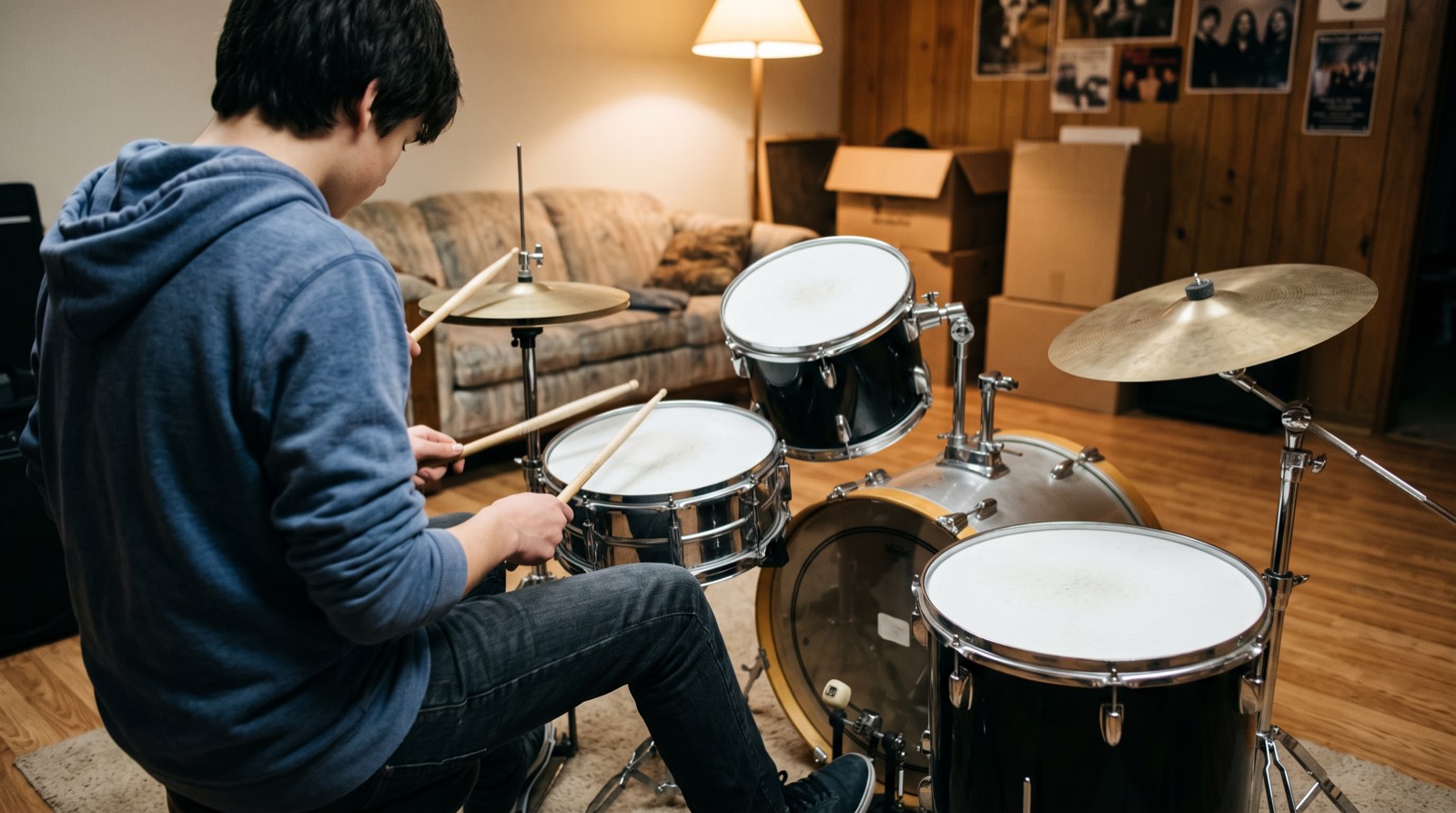
The basic rock beat is the first groove almost every drummer learns, and for good reason. It sits underneath an enormous amount of rock and pop music, and once your hands and foot can play it together, you can play along to real songs. This tutorial breaks it into small steps, so each part is easy before you put them together.
Count it first
Drummers count out loud: "one and two and three and four and." Each number is a beat, and each "and" sits exactly halfway between two beats. Count it steadily a few times, clapping on every number and every "and." Those eight even claps are eighth notes, and they are the backbone of this beat.
The three parts
- Hi-hat plays every count: 1 and 2 and 3 and 4 and. It keeps time.
- Snare drum plays on 2 and 4. This is the backbeat, the part you clap along to at a concert.
- Bass drum (the kick) plays on 1 and 3.
On most kits, a right-handed drummer plays the hi-hat with the right hand crossed over, the snare with the left hand, and the bass drum with the right foot.
Build it in four steps
- Hi-hat alone. Play the hi-hat on every count while counting out loud. Keep it even and relaxed. Play it until it feels boring, which means it is steady.
- Add the snare. Keep the hi-hat going and add the snare with the other hand on 2 and 4. On those counts, both hands hit at the same time.
- Hi-hat and kick. Stop the snare for a moment. Play the hi-hat with the bass drum on 1 and 3.
- All three together. 1 is hi-hat and kick, 2 is hi-hat and snare, 3 is hi-hat and kick, 4 is hi-hat and snare, and every "and" is hi-hat alone.
Go slowly. A slow, steady beat is worth far more than a fast, shaky one. A metronome set around 60 to 70 beats per minute is a good start, and you can nudge it up a few beats at a time as it gets comfortable.
No kit yet? Use a pad and your foot
You can learn this beat without a drum kit. Play the hi-hat part with one stick on the edge of a practice pad, the snare part with the other stick in the middle, and tap your foot on the floor for the bass drum. The coordination you build transfers straight to a kit. Our guide to holding drumsticks covers the grip that makes this easier.
Your first variations
Once the beat feels solid, change one thing at a time and listen to how the feel changes.
- Add a kick on the "and" of 3. This one small change appears in countless songs and gives the beat a push.
- Play the hi-hat on the beats only (1, 2, 3, 4) for a lighter, more open feel.
- Move the hi-hat hand to the ride cymbal for a bigger sound in a chorus.
Play along with music
As soon as you can play the beat steadily, put on a song at a comfortable tempo and play along. It is the most fun way to practice, and it teaches you to lock in with a band. Start with slower songs and work up.
Drum lessons in Denver
Getting the hands and foot to cooperate is the first big hurdle, and a teacher can show your child exactly where the coordination is slipping. Music 4 Humans drum teachers teach kids, teens and adults at our recording studio in southwest Denver and online.
Tell us about your child and we will match you with a drum teacher, or read our guide to a first drum lesson.
Common questions
Why do my hands and foot keep getting mixed up? Everyone goes through this. Slow down until all three parts are easy, and count out loud. Coordination comes from repetition at a slow speed.
I am left-handed. Should I set up the kit the other way? Some left-handed drummers flip the whole kit, and some play a standard kit. Ask your teacher, who can help you choose before habits form.
How long until I can play along with songs? Many beginners can play this beat along with a slow song within a few weeks of regular practice.