

How to Write a Melody When You Are Just Starting Out
Published
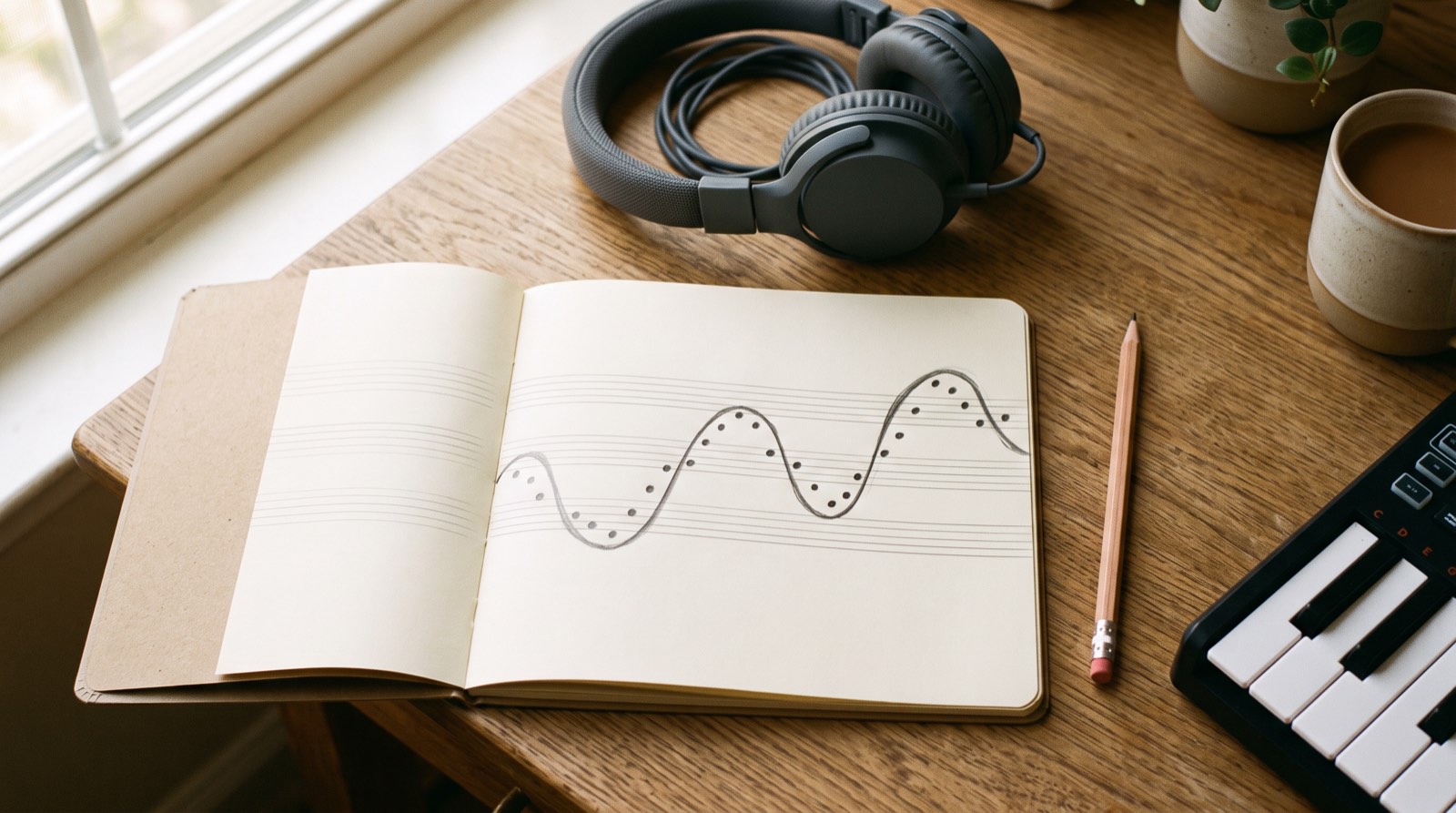
Good melodies rarely arrive fully formed. Most memorable melodies grow from a small idea that gets repeated and changed. In this tutorial you will learn how to come up with that small idea, shape it into a melody, and land it in a way that feels finished.
Start with a motive
A motive is a short musical idea you can play again and change: a few notes, or a few beats. Think of it as the seed of a melody. A strong motive passes a simple test. It is short. It is distinct, so you would recognize it next to other ideas. And you can vary it without losing it.
Here is the exercise we give our production students. Set a timer for ten minutes and capture five different ideas. Hum into your phone, tap them out, or draw them in the piano roll. Do not judge any of them until all five exist. Then pick the one you would want to build a song from, and write one sentence about why. Making several and then choosing is how professional writers work too.
Steps, skips and leaps
Melodies move in three ways. A step goes to the very next note up or down. A skip jumps over one note, like C to E. A leap jumps further. Melodies made mostly of steps feel smooth and singable. Skips and leaps add excitement and are easy to remember.
A reliable recipe is to move mostly by step and use a leap for an important moment, then step back the other way after the leap. That balance is a big part of why so many famous melodies feel natural to sing.
Know where home is
Every key has a home note, called the tonic. In C major it is C. Melodies that end on the tonic feel finished. Ending on another note feels like a question, which is useful at the end of a verse but unsatisfying at the very end of a song.
The fifth note of the scale, called the dominant (G in C major), pulls strongly back toward home. Try a phrase that ends on G, then answer it with a phrase that ends on C. That question-and-answer feeling is one of the oldest tools in music.
Build a melody in four phrases
- Phrase 1: play your motive.
- Phrase 2: play it again with one small change, like a different last note or a new rhythm.
- Phrase 3: go somewhere new, higher or with a leap, to build interest.
- Phrase 4: bring back your motive and end on the home note.
The pattern is repeat, vary, contrast and return. This shape works over almost any chord loop, including the progression from our guide to the four chords behind hundreds of songs.
Fit the melody to your chords
Melody notes that match the chord underneath sound stable. On a C major chord, C, E and G are safe landing notes. Notes in between are fine when you pass through them, but land on chord notes at the start of each bar and on long notes. If something sounds sour, check whether a long note is clashing with the chord, and move it one step.
Make it singable
Sing your melody out loud, even if you are making instrumental music. If you cannot sing it, it is probably too jumpy or too long. Leave space for breath between phrases. Some of the catchiest melodies are only five or six different notes.
Learn music production in Denver
A teacher can help you take a melody from a hummed idea to a finished track. We teach music production and songwriting one on one, for teens and adults, at our recording studio in southwest Denver or online.
Tell us what you want to make and choose music production in the form, or read more about music lessons in Denver.
Common questions
Should I write the melody or the chords first? Either works. Many producers start with a chord loop and hum over it. Others start with a melody and find chords that fit afterward.
How long should a melody be? Four phrases of two bars each, eight bars in total, is a great length to practice with.
What if all my melodies sound the same? Change the rhythm before the notes. A new rhythm on the same notes often sounds like a brand new idea.