
The Piano Roll, Explained for Beginners
Published
The piano roll is where most modern music gets written, and it looks confusing until someone explains one simple idea: it is a keyboard turned on its side. Once that clicks, you can write melodies, bass lines and chords even if you have never had a piano lesson.
How the piano roll is laid out
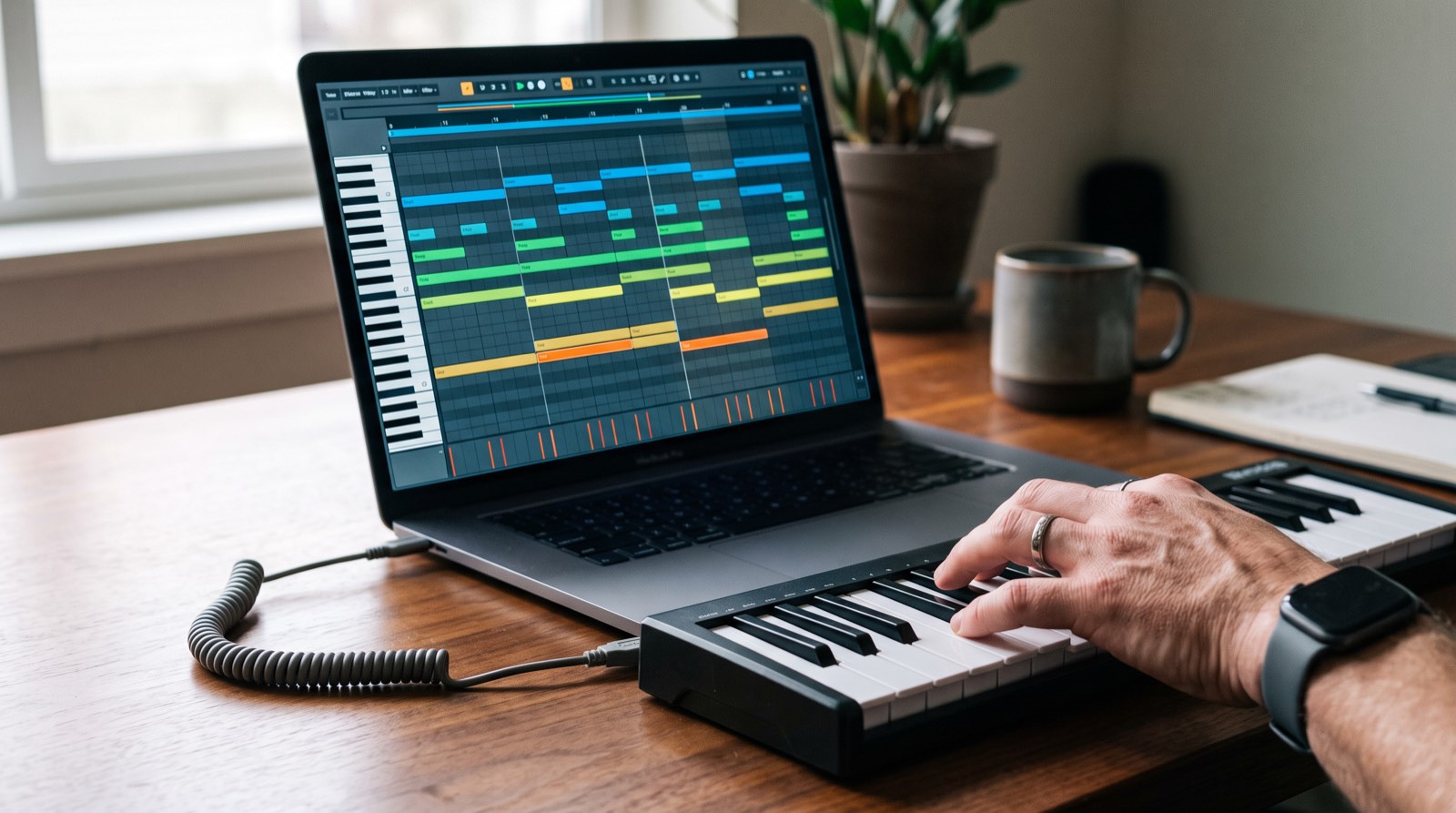
Look at the left edge of the piano roll and you will see a small keyboard standing upright. Every row across the screen belongs to one of those keys. That gives you two directions to think about.
Up and down is pitch. Higher rows are higher notes, lower rows are lower notes. The darker rows are the black keys, and just like on a real keyboard they come in a group of two and then a group of three. Those groups are how you find your place without counting.
Left and right is time. Each column is a slice of the beat, and the music plays from left to right. A note that sits further right happens later.
A note is drawn as a bar. Where it starts is when it plays, its length is how long it lasts, and the row it sits on is the note it plays.
Your first four notes
This is an exercise from our production classes, and it works whether or not you have a keyboard.
- Add an instrument track, such as a piano or a soft synth, and open its piano roll. In Soundtrap, the piano roll opens when you work with a MIDI instrument region.
- Play one note on your keyboard, or click one key on the on-screen keyboard at the side.
- Find the row for that note and draw a bar on it that lasts one beat.
- Press play. If the note you hear is not the note you played, delete it and try again.
- Repeat with three more notes, and make at least one of them a black key.
Play first, then find the row. Training your eye to connect a sound with a row is the whole skill.
Editing notes
Once notes are on the grid, you can shape them. Drag a note up or down to change its pitch. Drag its end to make it longer or shorter. Drag the whole note left or right to move it in time.
The grid helps you keep everything in time, because notes snap to the nearest line. If your notes feel stiff, try a finer grid or turn snapping off for small adjustments. Most piano rolls also let you change each note's velocity, which is how hard it is played. Lower velocity sounds softer and gentler. Changing velocities is one of the easiest ways to make a part sound less robotic, which we cover in more depth later in this series.
Drawing a simple melody
Try this in C major, which uses only white keys. Start on C, step up to D and E, then jump up to G, and come back down to C at the end. Give some notes one beat and some two beats. You have just written a melody with steps, a skip and a return home, which is the shape a huge number of melodies share.
Drawing chords
A chord in the piano roll is just notes stacked on top of each other at the same time. For a C major chord, draw C, E and G all starting in the same column. Move all three up together to make other chords. If you have made your first beat, try replacing the chords you played with ones you drew here.
Learn music production in Denver
A teacher can sit beside you in the piano roll and turn the ideas in your head into parts on the screen. We teach music production one on one, for teens and adults, at our recording studio in southwest Denver or online.
Tell us what you want to make and choose music production in the form, or read more about music lessons in Denver.
Common questions
Do I need to read music to use a piano roll? You do not. The piano roll shows pitch and time as positions on a grid, so many producers write music this way without reading notation.
What is MIDI? MIDI is information about notes: which note, when, how long and how hard. It is not sound itself, which is why you can change the instrument after you have written the part.
Should I learn piano too? It helps a lot, and even a little keyboard skill makes the piano roll faster. It is not required to start.