What Age Should My Child Start Guitar Lessons?
Published
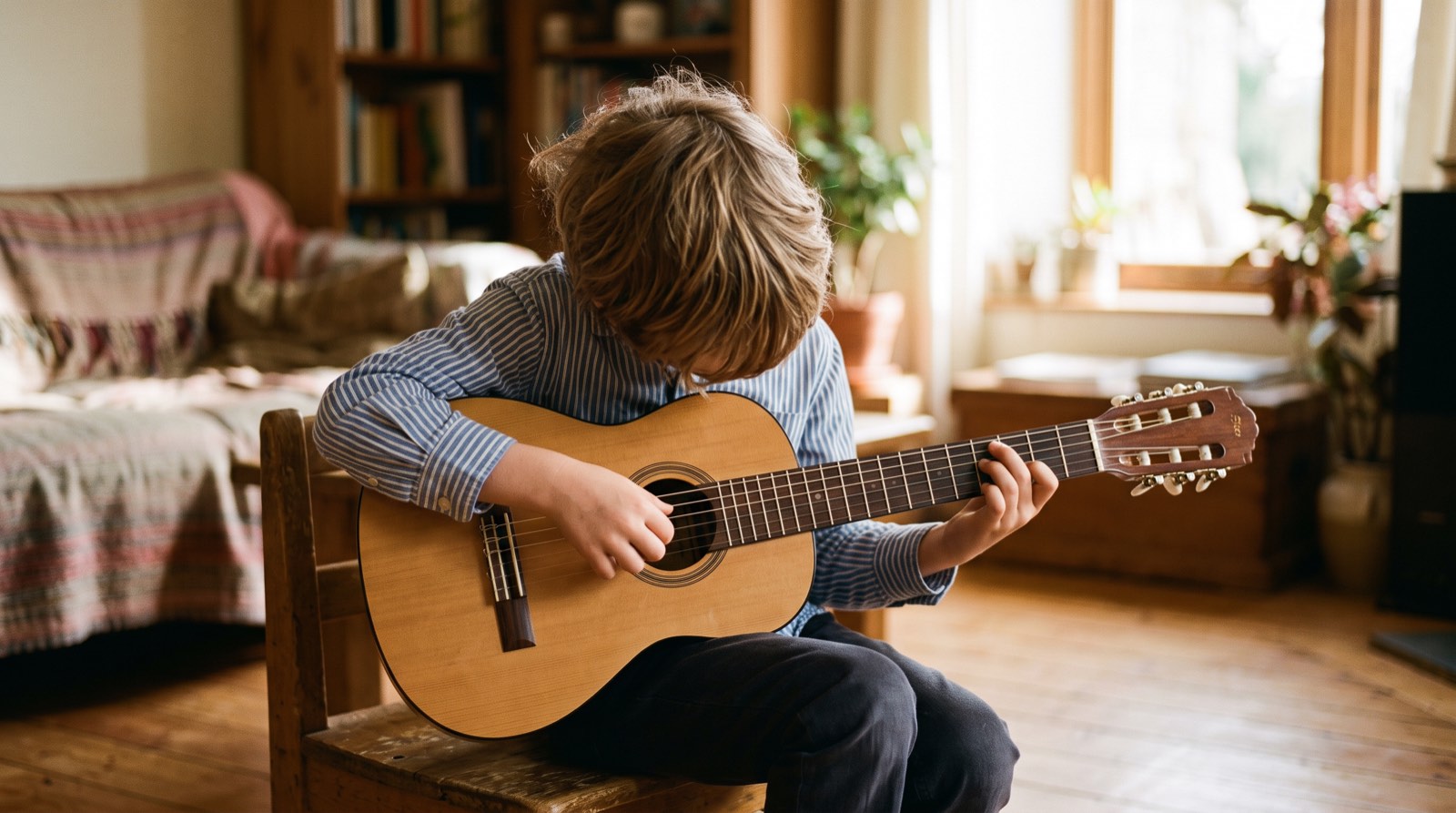
Most children are ready for guitar lessons around 7 or 8. Some start happily at 5 or 6 on a small guitar, and plenty begin at 10, 15 or 45. Guitar asks a little more of young hands than piano does, because the strings have to be pressed down firmly, so physical readiness matters more here than it does for most instruments. Interest still matters most of all.
This guide covers how to tell whether your child is ready, what to expect at each age, and how to give a younger child a good start.
Signs your child is ready for guitar
- They can hold a small guitar comfortably. Sitting down, with a half-size or three-quarter-size guitar on their leg, they can wrap one arm around the body and reach the first frets with the other arm, elbow still a little bent.
- They have some finger strength. Pressing a string down hard enough to make a clear note takes effort at first. Children who can do up buttons, use scissors and hold a pencil well usually manage.
- They can focus for about 20 to 30 minutes. Guitar lessons for young children are short, but they still need to sit, listen and try things a few times.
- They can cope with a little discomfort. Fingertips get sore for the first few weeks. A child who can push through gently, with breaks, will get past it.
- They are asking for it. A child who keeps picking up a guitar, air-guitars along to songs or asks for lessons will go further than one who was signed up without much enthusiasm.
Age by age
Ages 4 to 6. Most children this age find a guitar hard to hold and the strings hard to press. A ukulele is a lovely start: it is small, light and has four soft nylon strings, and the chord shapes carry over to guitar later. Some 5 and 6-year-olds do well on a half-size classical guitar with a patient teacher.
Ages 7 and 8. This is when most children start. Their hands have grown enough for a small guitar, they can follow a lesson, and they are motivated by playing songs they know. A three-quarter or half-size guitar with nylon strings is the usual choice.
Ages 9 to 12. A great age to begin. Children this age progress quickly, can practice on their own, and often have strong opinions about the music they want to play, which keeps them going.
Teens and adults. It is never too late. Teens often come in wanting to play in a band, write songs or learn a particular riff, and that goal drives fast progress. Adults start from scratch all the time.
Start with the right size and type
A guitar that is too big is the most common reason young beginners struggle. If your child's arm has to stretch straight to reach the first frets, the guitar is too big. Our guide to nylon-string and steel-string guitars explains why nylon strings are much gentler on young fingers.
If your child is not ready yet
That is completely fine. Keep music in the house: singing, clapping along to songs, a ukulele or a small keyboard. A child who was not ready at 6 is often ready at 7, and the time spent with music in between is never wasted.
Guitar lessons in Denver
A trial lesson is the easiest way to find out whether your child is ready, because a good teacher can tell within one lesson. Music 4 Humans guitar teachers teach kids, teens and adults at our recording studio in southwest Denver and online. We also run after-school music classes at five Denver schools.
Tell us about your child and we will match you with a guitar teacher who suits their age, or read about guitar lessons in Denver.
Common questions
Is 5 too young for guitar? It is early, but not always too early. A 5-year-old with a half-size guitar, real interest and short lessons can do well. Many do better starting on ukulele.
Is 12 too old to start guitar? Not at all. Twelve is a very good age to begin, and older beginners often progress faster than younger ones.